Infographic: What is the deal with Green jobs?


In this Infographic, Jobvine breaks down the soaring sector of our economy which provided 2,700,000 jobs in 2011.


green jobs Infographic: What is the deal with Green jobs?

Who’s getting in on the “green”?


Staples’ Career Site Targets More Generations, Highlights Employee Stories

therisa 150x150 Staples’ Career Site Targets More Generations, Highlights Employee Stories

Therisa D'Amato

Staples Canada recently introduced a new career site new career site. The site is impressive, entertaining and welcoming. It showcases stories from different Staples’ employees as well as different career paths an applicant could take. We sat down with Therisa D’Amato, Regional Human Resources Director of Staples’ , the lead on the ground-breaking project to discuss its development. callout Staples’ Career Site Targets More Generations, Highlights Employee Stories

D’Amato began the project by researching how Staples’ could better use Social Media in recruitment. After a colleague and she did additional research, they decided they needed to revisit their career site: Staplesville.  Staplesville was created three years ago as result of research on Gen Y candidates. They were looking for a new way to attract quality candidates for their hourly and retail positions. The site has a game-like experience where you explore the world of Staplesville and discover the culture and career paths you can take as a Staples’ employee. It also included a clever YouTube video:

Staples’ hired Angus Reid to do some market research and conduct some focus groups in order to study it further. The response was clear: Staplesville was hitting its mark…a little too well. Though the content applied to most candidates, the navigation and presentation turned anyone outside of Gen Y off. They needed to find a way to appeal to all generations, not only the digital natives. Additional studies and research uncovered that Staples’ was seen as “just retail” and many were not aware of the multitude of opportunities for corporate and management positions.

At that time, D’Amato and her team decided a new career site had to be born. They needed a site that would have the spirit of Staplesville with a wider appeal for corporate applicants, management applicants and applicants outside of Gen Y.

D’Amato and her team collected all the employee stories and developed the content to ensure it was authentic to Staples’. The career paths were polished and the site was launched. The end result looks finished and friendly, it highlights the people of Staples’ and welcomes applicants.

If you’re interested in creating a site like Staples’, Therisa offered this advice, “Stay rooted in the research.” Staplesville will live on due to its success with Gen Y-ers; but now every candidate whether they’re Boomer, Gen X, or Gen Y will be welcomed into Staples’ employee culture.


The Recruiting Continuum: Dissecting and Defining the Recruitment Process

continuum4 The Recruiting Continuum: Dissecting and Defining the Recruitment Process

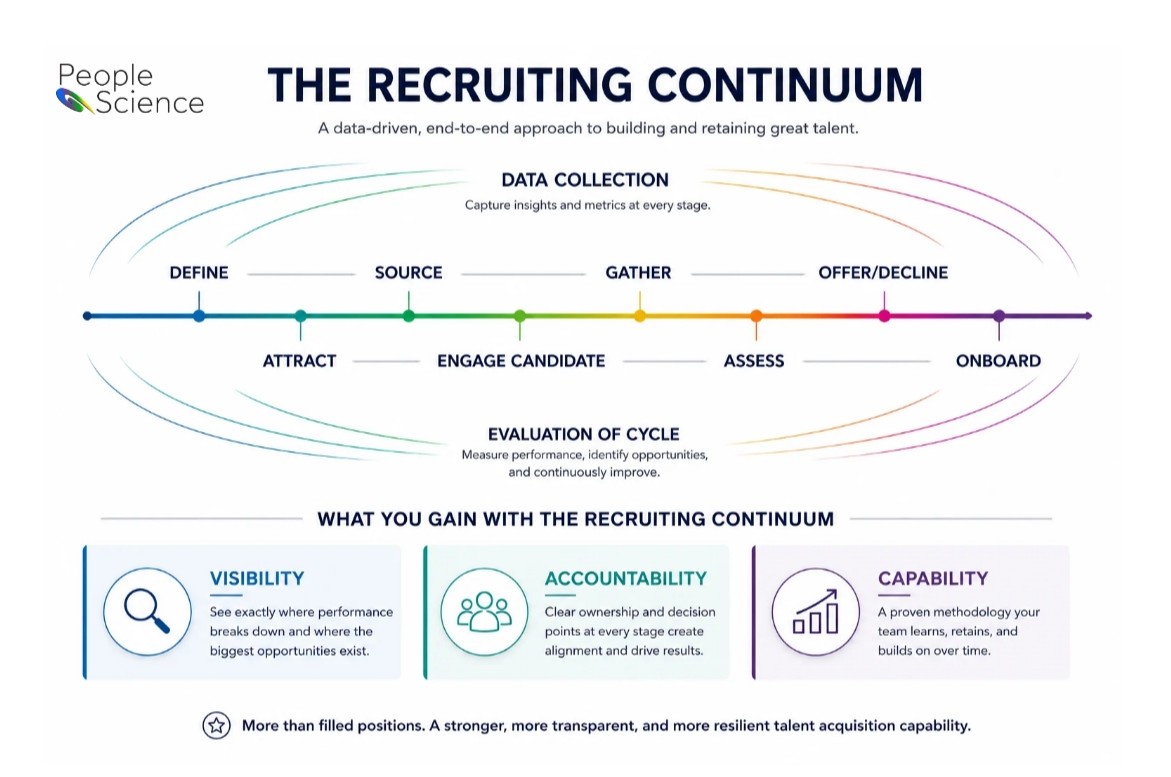
The cornerstone to our success is the Recruiting Continuum. The continuum sequentially demonstrates the elements of recruitment while clearly identifying the connectivity of each portion to one another. Each segment of the identified elements is present in even the simplest recruiting endeavor. The better each element operates, the better the result of the recruitment effort as a whole.

When a client engages our services in Recruitment Process Outsourcing, we utilize the continuum to focus on where the client is lacking in each segment and closing the gaps to reach higher efficiencies and better results. Additionally, we continuously measure our own performance against the expected efficiencies of the continuum. This allows us to identify challenges and quickly address them, moving to solutions often before our clients experience the “pain.”
In a series of articles, we will examine each segment of the continuum. The first is Define and Attract.

Define and Attract

Define and Attract is best explained by “what is the position?” and “How are you presenting it?” Regardless of whether or not the position is formally designed or simply an idea, definition always occurs. The depth and breadth of definition plays a critical role not only in the search but in the streamlining of the search. All the parties involved in the recruiting process must fully understand the scope of the position (HR, Marketing, Business Managers, Hiring Managers, Search firms). When each party works together in harmony it results in better hires in a shorter time frame.

Accordingly, ”Attraction” follows suit. When a fully defined position is completely understood, the outreach for a candidate will become more accurate making the search easier and more pinpointed.
Following are a few steps to take to assure an effort in Defining and Attracting is efficient.

Clear expectation of type of hire
The first step in the recruitment process is identifying the need for a new hire. Ideally the Hiring Manager and recruiter together determine what an ideal candidate looks like and what attributes and skills they might possess. In consideration they can utilize, create or re-create a job description. In every case documenting and grading the most important skills by number provides the foreground for an accurate execution.

Effectiveness or presence of employment branding
The next step is to examine how the company and or this position is viewed in the current recruiting market. If there is no specific employment branding designed, what does the candidate see? What steps can be taken to present the company as the employer of choice? How should the company position itself to the pointed audience? Working with marketing the talent team should assure the right recruitment branding message is being delivered to the right market.

Documentation of advertising plan
This leads us to documentation of the advertising plan. Once the best candidate is determined, where do they reside? What vehicles will reach this market? What number of candidates should be driven to the company as compared to actively recruited? In today’s recruiting market, so many different vehicles can be used to attract candidates. Which of those best suits the specific position?

Once a general idea of how many candidates should be funneled through specific sourcing techniques is determined, document the plan fully and track all results as the effort is being executed.

Measuring and monitoring recruitment vehicles
The next step is monitoring, adjusting and re-adjusting all the vehicles to recruitment. Since advertising is only one portion, what candidates are finding you from a simple Google search? Set up a detailed tracking system for all sources. Be sure to include employee referrals, the career site for your company, social networking, job boards, job fairs, and additional sources as needed. As recruiting begins which methods and vehicles are providing quality as well as quantities of candidates?

NOTE: Most Applicant Tracking Systems capture this data but in our experience, most are not accurate as they rely on the candidate to supply the data at the application stage. The most reliable data comes from an actual personal encounter with the candidate(s).

Employment Website
Your career website is more than likely the first view of your company and what it “feels like” to be an employee. When your career page is easy to find from your main webpage, it welcomes new candidates. If it is easy to navigate it encourages them to stay engaged and apply for a position. Statistics show more and more targeted candidates will go to a company’s website before even checking the job boards. Companies which spend the time to develop an effective employment website ensure their place at the head of the pack for the best candidates. While in the lead, companies should take this chance to entice the best of the best- welcoming confirms the candidate’s original idea that the company is a good choice.

The implementation of a mobile site will be very beneficial to most candidates but especially those targeted in Information Technology, Engineering, and the millennial generation.
Defining and attracting the best candidates at the beginning of the initiative will get you off to a good start. Using the right techniques to recruit to your best audience is next. We’ll outline effective Recruiting in our next article or read www.people-science.com to get a jump start in advance of its publication.


Applicant Tracking Systems = Relationship Management System


by Stephanie Lafferty and Anthony Vodola

Most Applicant Tracking Systems (ATS) that we see on the market today tend to look and feel relatively similar. While you will be able to customize some aspects of the ATS to suit the needs of your internal processes, you’ll find yourself conforming to a number of their standardized options during the implementation stage. This, of course, forces you to disregard your already established and fully effective processes. We’ve all heard this story before. The bottom line is most stock ATS providers, while somewhat customizable, are not as flexible or robust as we’d like them to be. Why then, if we’re aware of this inevitable headache, would we concede to it?

At People Science, because we have yet to find a system that encompasses all the modules we need, we have developed a fully customizable ATS: EMC2. Designed with Albert Einstein’s famous equation in mind, EMC2 is modeled after the scientific realization that when we speak about mass and when we speak about energy, we are referring to two forms of the same thing. In our recruiting continuum there are two elements that appear quite different but in fact hold equal significance: Candidate Processing and Data Collection & Reporting. The thought of instituting anything short of a robust yet agile apparatus that could not work with these elements was out of the question. When the mass of information entering the system doesn’t seem to match the energy output that is being managed, extracted, and reported on all the data captured; it is at that point that one must aim to institute a true Relationship Management System, which is exactly the type of tool the recruiting industry will be in need of in the near future.

The Recruiting Continuum

continuum4 Applicant Tracking Systems = Relationship Management System


EMC2 is a Relationship Management System (RMS) at its finest; it manages the candidate experience from the initial contact forward, collecting data pertinent to the candidate’s job search, including their historical experience, current work through to their projected career path. This allows available talent pools throughout various industries to be transparent to our recruiters, who then work toward connecting candidates with the right position at the right time. The robustness of EMCmoves away from reactive behaviors and brings the proactivity of our recruiters to a brand new level. To conclude, EMC2 as an RMS maintains not only the collected data on the applicant but also manages the recruiter—candidate relationship, harboring essential quantitative data coupled with a “relationship timeline.” Every candidate wants a recruiter that is out for his or her best interest, and every recruiter needs an endless pipeline at his or her disposal—EMC2 brings these two elements together and provides the relationship in a tangible system.

For more information on how EMC2 can help your company, contact us or give us a call at 888-924-1004.


Will the Creation of 100,000 Customer Service Jobs in the US Increase Customer Satisfaction?

In a nationwide survey from Consumer Reports, sixty-seven percent of respondents had hung up on customer service without having their problem addressed. What can be done to address this problem?

One group has formed to create 100,000 customer service representative jobs in the US in an effort to help improve both customer service and the economy. The group, called Jobs4America, is a coalition of firms and customer service companies including Sprint, Nextel, XO Communications, the American Teleservices Association and third-party customer service providers such as Accent Marketing Services, Aegis Global and Novo 1.

On Jobs4America’s website, they offer 3 reasons to increase on-shore call centers:

  • Create US jobs
  • Create jobs for the Disabled (via telecommuting)
  • Improve Customer Satisfaction

The first two reasons are inarguable but the last reason is supported with questionable data. They cite a study which reports customers feel 27% less satisfied when they believed they were talking to an off-shore worker.  There was no actual data collected as to whether it was or was not an on or off-shore call center; it was completely based on the perception of the customer. What isn’t obvious is that once a customer perceives the customer service representative is off-shore, it is much more likely that there was already an issue which impeded communication.

Some have asserted that off-shoring customer service doesn’t affect customer service as long as the customer service representative is “understandable” and provides “good quality answers.”

Complaints relating to customer service go beyond the on-shore vs. off-shore debate. In the Consumer Reports survey mentioned earlier, customers ranked the issues that annoyed them the most. Topping the list was “Can’t get a human on [the] phone.”  A majority of customers prefer to use the phone to address their problems. Despite their preference for the telephone, widespread use of automated menus is the cause of frequent complaints. Almost half of the people who reach an automated telephone menu will bypass the options to try to speak with a human directly.  “Seventy-one percent of survey respondents were “tremendously annoyed” when they couldn’t reach a human on the phone. And 56 percent felt that way about having to take multiple phone steps to reach the right place. (CR)”

The take-away from all this?  On-shoring Customer Service jobs should boost the economy and lower unemployment. However, don’t expect complaints to disappear without the proper infrastructure manned with qualified and trained customer service representatives. What the customer cares about is reaching a human that can understand…and solve their problem.


Social Recruiting Rules of Engagement

Jobvite social recruiting plans Social Recruiting Rules of Engagement A recent survey revealed 89% of companies plan to use social recruiting this year (Jobvite). Utilizing social networking from a recruiting perspective is a tricky task. As a recruiter I had been leery of using social networking to market my positions. I didn’t want to have to inundate my friends and colleagues with available jobs and be “that guy” on LinkedIn and Facebook. Using the following tactics, I was able to turn my suspicions about social networking around and see how it can indeed benefit me professionally.

As a recruiter, you must take the time to cultivate and engage your network. You need to make your network want to be involved with you and your organization. Just as you wouldn’t go up to someone you didn’t know at a cocktail party and offer them a position without introducing yourself or creating a rapport, you shouldn’t expect to do the same on social media.

Some rules of engagement:
1. Engage your network, ask questions, be open to a dialog and differing opinions

2. No overuse – you don’t want to be the person who is abusing their network and overtalking about the job they have and need to fill.

3. Transparency is key – ask your network if they would mind if you occasionally posted about a job or asked them for leads and opinions.

4. Treat your social network as though you were seeing them in person with every interaction, what’s socially acceptable in a professional environment or event is still the guideline you should follow when interacting professionally on a social network.

Differentiating the social media outlets from the job board direct posting style is the number one hurdle for most recruiters. We have been craving the “quick fix” that mass postings and advertising provided without realizing the “social” or “networking” aspect of these types of forums. Joining groups and forums is the best way to engage in the dialogue within these groups. This enables you to establish a conversation and rapport with your target demographic. Then you can go out on a limb and create your own group.

Once you have a presence, people won’t mind the occasional job posting or a plea for help with a hard to fill position. In fact, they will want to help you and point you in the right direction. Most importantly, they won’t see you as “that guy,” they won’t hide your posts and think you’re the creep in the corner who only comes out to sell an impossible job.


State of Social Recruiting Infographic Social Recruiting Rules of Engagement


‘Embedded’ workers less likely to quit

embeddedworker 300x229 ‘Embedded’ workers less likely to quitTEXAS A&M (US) — To get ahead of turnover—and prevent valuable employees from leaving—employers need to know how “embedded” workers are in the job.

“Are they satisfied, embedded, on the fence?” says Wendy Boswell, a business professor at Texas A&M University. “Are they flight risks? If so, and if they are top employees, you might be wise to invest in trying to retain them.”

A new study by Boswell and colleagues—published in the Journal of Applied Psychology—examines factors that may help explain under what conditions employee job search effort may most strongly or weakly predict subsequent turnover. The decision to leave a job is a complicated process, the study suggests. How attached an employee is to the current environment—or how “embedded”—is a critical factor.

“How tied you are to not only the place but also the community—if you own a home, your spouse has a job there, you belong to a church or are involved in schools—determines how much incentive it takes to get you to leave,” Boswell explains.

“Fit” is also important—whether the values of a community (as well as the organization) align with the individual’s—and characteristics such as metropolitan versus small-town, or urban versus industrial.

“The practical implication for an employer is to know who is really vulnerable to leaving, then going and intercepting those high performers—retention isn’t ‘one size fits all,’” says Boswell.

The culture of the organization and community also carry great weight in the decision, says doctoral candidate Brian Swider, who collaborated on the study.

“Say I’m working in New York City and a job opens in a small southern suburb. Whether I pursue that opportunity depends on my personal preferences,” he says. “It could be the opportunity I’ve been waiting for or it could sound like a nightmare.”

Employers do a poor job of predicting impending turnover, Swider says. These findings suggest that there may be a number of factors interacting to influence employees’ turnover decisions, indicating greater complexity to the process than described in previous prominent sequential turnover models.

Boswell explains the assumed process: an employee experiencing job dissatisfaction searches for alternatives, evaluates them against his current position, then either quits or stays put. But, oftentimes, employees search and don’t leave.

Online applications make it easier to search and even apply for positions, but the likelihood of an employee actually accepting another position depends on his level of enmeshment or “stuckness,” as well as how important it is for the person to leave and whether he or she even has the opportunity.

“The more of these attachments you have, the more likely you are to want to stay somewhere,” Boswell explains. “It used to be the defined benefit plan, but now it is all these other factors that you might have to sacrifice if you were to leave.”

More news from Texas A&M University: http://tamunews.tamu.edu

Via Futurity.org


Should Twitter be banned or required?

While many companies have struggled to limit or ban the access of twitter and other social media, People Science is requiring it. For the last two months, each employee at People Science chose a day to tweet about their personal impressions on our twitter account @People_Science. Our goal is to show what the inner workings of an RPO look like. In the time since we’ve started the “day in the life” our follower count has nearly doubled. Read a selection of  tweets from our employees below:

Loading Quotes...

We started a little over 2 months ago but the results are staggering: our Follower count has more than doubled and continues to grow quickly. However, our true goal has nothing to do with numbers: show the public what it’s like to work at People Science. What do you think, have we achieved our goal? Let us know in the comments or on Twitter.


5 Innovative Ways to Reduce Turnover

It seems like every week a survey comes out with a new shocking statistic about “the talent exodus” and how all of your employees (well… 84 percent) are looking for a new job. What can you do to keep them from leaving your company? The cost of turnover is high.  It can vary widely between 30-150 percent of the yearly salary depending on the position and how you calculate it: cost of vacancy, time to fill, etc.  Reducing “churn”  is a highly effective way to boost your bottom line.

Hiring the right people to start is key, as is fair compensation and benefits, but below you’ll find some “out of the box” ideas other companies have put in place to  reduce turnover (in one example, only 1 hire left in their 10 years history):

5.  Creating a dog-friendly workplace: According to a survey by American Pet Products, 1 in 5 companies allow pets in the workplace. It goes on to state that companies that allow pets in the workplace see a lower rate of employee absenteeism, more willingness to work longer hours, and an overall more productive environment.  “Dog-friendliness may generate more loyalty for the company as a whole. “ (INC)

4.  Referral Hiring: When a current employee recommends a friend for a job at your company, it might be less for the cash bonus and more for the “bonus” of working with someone they like.  It’s more likely that the hire will fit in with your company culture and stay with the company for the long run.

3.  Gamifying: “Gamification is the process of making non-game things more game-like, such as making a business contest more competitive by adding a leaderboard or achievements. At the U.K.’s Department for Work and Pensions, they created a game to foster innovation and social collaboration and within 18 months there were over 4,500 users. ” (Venturebeat) Gamification introduces an addictive reward system which identifies goals and highlights the employees’ accomplishments (all tenets in reducing turnover).

2.  Food: Providing healthy meal options within your office leads to more productivity, inter-office camaraderie, happier and healthier employees, and…surprise…lower employee turnover. When companies, like Google, offer employees gourmet meals, there isn’t much reason to go “off-campus.” Employees spend less time out of the office and your competitors lose the opportunity to take your top talent out to lunch.

1.  Telecommuting/Work Flex: Whenever a survey or study is presented about the desire for telecommuting, it’s persistently a top motivator. At People Science, we’ve embraced telecommuting for its many benefits.

Fire Engine RED, a Philadelphia-based company has embraced telecommuting in a different way. Their company is 100 percent virtual; they recruit worldwide for the “perfect candidate” without worrying about their location. The proof in this model is in their turnover: in 10 years only one employee has left, ironically to become a client of the company.  (INC)

ROWE: Researchers studied the effects of implementing a Results Only Work Environment on 600 employees at a Best Buy in Minnesota.  The study found that ROWE reduced turnover by 45 percent and only 6 percent of participants left the company during the study period versus 11 percent in the control group. Turnover “intentions” were also reduced (ASA)

At People Science, our Recruitment Process partnerships always result in reduced new hire turnover.

  • In one example, we were able to reduce new hire turnover from 98 percent to 28 percent within 18 months.
  • For another client we reduced new hire turnover from 42 percent to 11 percent in a 12 month period.
  • Additionally, our partnerships result in a higher caliber of new employee.  A current client has witnessed a 25 percent increase in productivity with the new hires placed in the first 6 months.

If you are interested in learning the true cost of turnover and how you can reduce it, contact us.


Remote Recruiting

At People Science, we are always looking for new ways to enhance our work environment and offer employees creative benefits. So it is hard to believe that working remotely was not a benefit that we offered years ago. Our thought process was that we do have contractors that work remotely but because we attribute much of our success and company culture to the true team environment, we never seriously entertained “the work from home” benefits—until 5 weeks ago.

As gas prices increased significantly and many of our staff travel 30 plus miles to work, our VP of Placement Services decided it was time.

Keep in mind that we have an effective self monitoring management system that allows staff to track their own performance and this benefit is only available to fully trained established team members.

Here’s what our Team has to say about working from home…

“It’s easier to get into a zone and stay there with no one else around you”
“I seem to start earlier, end later and take a shorter lunch break on my telecommuting day as well!”
“I feel that working at home helps slow things down for me. I find it much easier to focus on my day from home. I am not pulled in so many directions and I can order my day more efficiently from the start.”
“I like the quiet environment and it seems generally less stressful.”

About their home office…

“My home office is currently my “man cave” as my family calls it or my “fortress of solitude” away from any distractions that may occur throughout the course of an ordinary day. “
“I’m set up where it’s nice and quiet with plenty of light. I have my desk set up in the center of the floor. A nice open space makes my day feel full of possibility.”

Many prefer to forgo their telecommuting when in a crunch period. A few prefer the mix of working both in home and the office:

“Can’t do it on critical meeting days, and also I don’t like to not be there to support the staff.”
“I miss the energy my coworkers provide, but I get that 4 days a week, so no worries.”
“Not having somebody right next to you to talk with, ask a question or even joke around with.”
“My dogs are sometimes not the best office mates – sometimes they have to get stuck outside”

There are many unexpected benefits…

“I’ll go kayaking or hiking before work”
“I think it was a great idea that really boosted the team morale.”
“I like relaxing in lounge clothes, eating a fresh lunch, not having to commute”
“I love working from home because it saves gas money and I don’t have to wake up as early. “
“With a long commute it’s like getting a raise because I don’t have to pay gas or tolls that day.”

For the time being, team meetings, client meetings and training are still done in person. In the future, webinars, video conferencing and other technology will encourage more remote telecommuting.

Read about how telecommuting along with other “out of the box” ideas can reduce turnover at your company. At People Science, our Recruitment Process partnerships always result in reduced new hire turnover. Contact us.


You are what you measure.